
Apraksts
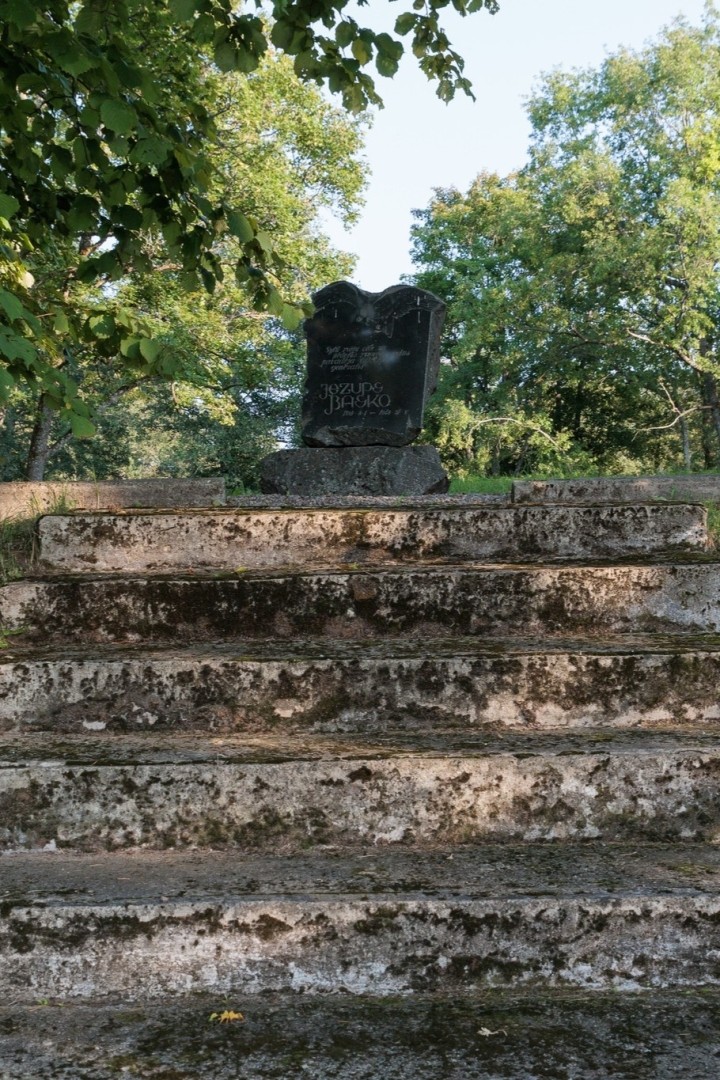
Jāzeps Baško was born on 9 January 1889 in Kastīre, Jasmuižas parish (now Rušona), Daugavpils County, into a large peasant family. He was the youngest of the children and had to contribute to the family’s livelihood from an early age by working as a shepherd. Despite the family’s poverty, his parents allowed him to attend school—first at Jasmuiža Primary School, and later completing the full course (3+2 years) at the Preiļi two-year school. His brother Kazimir was already working in Russia at the Belostok railway station at that time and took him in to prepare him for the Belostok Real School. In 1908, Jāzeps graduated with honours from this school and continued his studies at the Military School of Grand Duke Vladimir. Upon graduation, he was assigned to the sapper battalion in Smolensk, from which he graduated in 1910. In 1911, he volunteered for the aviation department of the Officers' Aviation School. On 15 August 1912, as part of a group of four pilots, Jāzeps completed the first long-distance flight in a hot air balloon, covering 900 versts and spending 15 hours in the air. In September 1912, Jāzeps graduated from the Aviation School and became a junior officer of the 7th Aviation Company. In 1913, he continued his education at the Gatchina Military Flying School, graduating as a military aviator. Recognizing Jāzeps' exceptional flying skills and talent, the High Command intended to keep him as a teacher at the Flying School, but all plans were disrupted by the outbreak of the First World War. At the start of the war, Baško was assigned to the 13th Aviation Company of the 6th Army. Soon, he was tasked with organizing the bombardier section, which was to use the then-new, and largest at the time, 4-engined aircraft—the "Ilya Muromets". Jāzeps Baško conducted numerous combat flights and led many battles, during which he was wounded and his health deteriorated. However, he also achieved great distinction. During the war, he flew approximately one-third of the total combat sorties flown by Russian bombers and set four world aviation records with the “Ilya Muromets”. Jāzeps Baško was awarded all the major Russian military honours of the time: four Crosses of St. George, the Order of St. George, two Orders of Vladimir, two Orders of Stanislav, and three Orders of Anna. He was recognized as the greatest bomber pilot in the world and one of the world's leading aviators overall—his name is inscribed in the Golden Book of Louis Blériot (Paris), known as the Golden Book of the world’s best aviators. At the end of the war, when a peace treaty was signed with Soviet Russia, Latvians were allowed to repatriate from Russia, and Jāzeps Baško decided to return home. In 1922, he joined the Latvian Army as Commander of the Aviation Division, where he took on the task of restoring the bomb-damaged Spilve airfield, reorganizing the division, drafting flight regulations, and overseeing other aviation-related work. Initially, Latvian aviation had to rely on worn-out aircraft left behind by the Germans. In 1924, the Aviation Division received new aircraft from Italy, but flight safety was still lacking, and accidents, sometimes fatal, occurred frequently. Continuing his work on Latvian aviation, J. Baško, along with representatives of the Armaments Administration, travelled to England, Czechoslovakia and other countries to purchase warplanes. Alongside his duties in the Aviation Regiment, he also lectured at the Aviation School, the Defence Aviators' School, the Military School, the Officers' School and even at the Catholic Theological Seminary. Jāzeps Baško contributed significantly to the training of young pilots by writing the books "Aeronavigation", the first book on aviation in Latvian, "Air Fleet Operations" and "Speed Chart". He authored many technical books and articles in periodicals such as Latvijas Kareivis, Spārnotā Latvija, Aizsargs etc. He also wrote new books like "Aviation Tactics" and "Aviation in Examples," and contributed articles on aviation and air navigation to the Latvian Conversational Dictionary. In 1929, he was assigned to the Higher Military School, and after graduation, he was transferred to the Technical Division Administration, where he was appointed Chief of Staff and Aviation Inspector. In 1938, he became Chief of Army Aviation, with the Defence Aviation Regiment and the Latvian Aero Club under his command. In 1938, Jāzeps Baško was promoted to General. For his significant contributions to the development of Latvian aviation, he was awarded the Order of the Three Stars, Third Class (1929), the Order of Vesthardus, Second Class, as well as many foreign orders and honours, including the Order of White Rose of Finland, the Order of the White Lion of Czechoslovakia, the Order of the Eagle of Estonia, the Order of Polonia Restituta of Poland, and other orders and honours. He possessed a vast amount of knowledge and experience in the field, which he dedicated to his work. In 1940, Jāzeps Baško retired and returned to his homeland to fulfil a long-held dream of resting in his native region.